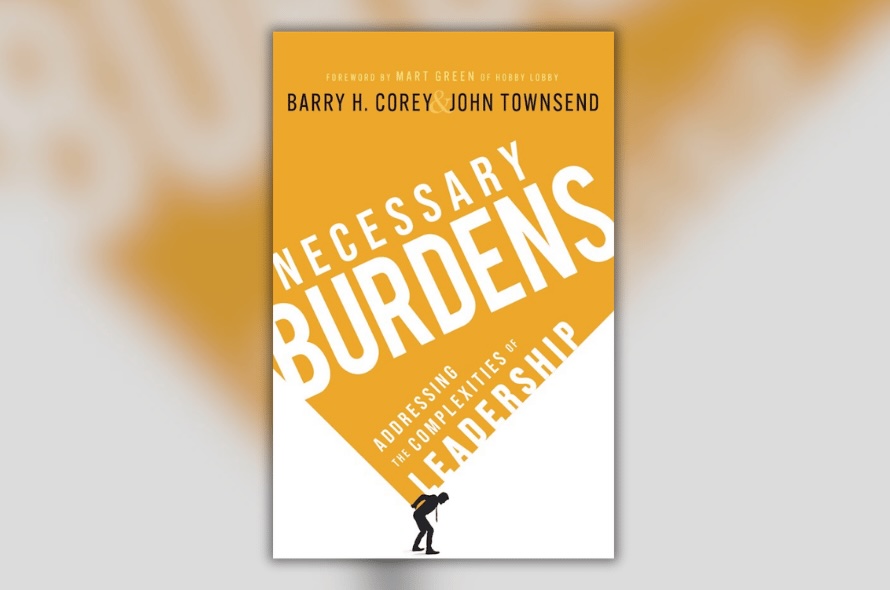
Barry H. Corey and John Townsend, Necessary Burdens: Addressing the Complexities of Leadership. (affiliate link). New Kensington, P.A.: Whitaker House, 2026. 224 pages.
Barry Corey has served as president of Biola University for nearly 20 years. In Necessary Burdens: Addressing the Complexities of Leadership, he reflects on the burdens top leaders must bear. At the end of each chapter, well-known coach John Townsend offers reflections and suggestions.
Corey identifies 14 “burdens” top leaders shoulder. Holding the top leadership position, he suggests, “will be both splendidly rewarding and agonizingly white-knuckling. You can’t have one without the other” (23). He claims that the “most demanding burdens of leadership weigh heaviest on the highest-ranking leader” (25). Although some readers might push back on this viewpoint, Corey argues that the top leader is peerless, facing challenges no one else in the organization fully understands. From the vantage point of lower-level staff, leaders might appear to enjoy numerous “perks.” And they do. But they also carry significant responsibilities and pressures that others may not appreciate.
The first burden Corey addresses is the “burden of loneliness” (39). He states, “Despite our need for friends, it is against your best CEO instincts to form close personal bonds with those reporting to you, directly or indirectly” (39). He suggests, “We need to find our peers elsewhere, because where we work, we are, and should remain, peerless” (41). I’m not sure I agree that a senior pastor, for example, can’t develop close relationships with members of his staff or congregation. But perhaps Corey is correct about CEOs.
Corey believes that coming to an organization from the outside can be an advantage. He observes, “In some ways, becoming the head of the same organization from within is more burdensome than coming to a new organization from the outside” (43). Leaders who rise through the ranks may find it difficult to prioritize the organization’s health over friendships they developed with colleagues along the way.
Corey also addresses the “burden of identity” (51). He avoids the first-person possessive pronoun when discussing his work, refraining from referring to “his” staff, office, or school (53). This practice helps him maintain a distinction between his personal identity and the organization he leads. As he explains, “. . . I’m but a temporary custodian of the office in a continuum of presidents” (54).
Opposition and criticism are inevitable, Corey acknowledges. He suggests, “More callouses create durability and resilience that will make the next bout less painful than the last one” (57). Adversity remains uncomfortable, but resilience can make it easier to endure.
Another challenge is the “burden of temptations.” Corey states, “Like it or not, when you are in the senior most role, the temptations become more complex and the consequences of succumbing more calamitous” (123). The issue isn’t necessarily that top CEOs succumb to temptation more frequently than lower-level executives; rather, their failures can have more devastating consequences. Corey writes, “Some leaders take themselves far more seriously than they take their roles” (130). Leaders who recognize the weight of their responsibilities may be better equipped to resist temptation.
Stress is another unavoidable burden. Corey manages work-related stress by keeping a journal under lock and key, giving him an outlet for frustrations he cannot express publicly (142). He suggests that “The main cause of vocational burnout is unrelieved stress” (180).
Corey also emphasizes the importance of recognizing one’s limitations. He wisely observes, “. . . I am but one chapter, not the whole book” (197). Leaders must remember that they are part of an organization’s ongoing story, not its central character. As Corey adds, “No leader is capable of infinite relevance” (203). He acknowledges, “There is almost always a point at which your best is no longer adequate for the role” (204). Experienced leaders must therefore prepare and invest in the next generation rather than assume their own leadership will remain necessary indefinitely.
I found much wisdom in this book, particularly its focus on the unique challenges an organization’s top leader faces. Yet that emphasis may make it less applicable to those further down the organizational chart. As president of a Christian university, Corey naturally draws many of his illustrations from higher education. Although his principles often apply more broadly, business leaders, for example, may find some of the academic examples less relevant.
The book’s format is largely effective. Townsend offers valuable insights and practical applications at the end of each chapter, though some responses revisit points Corey has already made. Corey’s discussion also occasionally becomes repetitive because some leadership challenges overlap across the 14 burdens. Nevertheless, the book contains plenty of nuggets of wisdom, and Corey is candid about his own struggles without oversharing.
Having served as a senior pastor and president of three organizations, I resonated with much of the book’s content. Despite some repetition and a somewhat narrow focus, I believe it can be a valuable resource for top leaders.
Rating: 3
Leave a Reply